Small Pets – Rabbits, Hamsters & Companion Animals
small pets is an important topic for pet lovers and users searching online. This page provides clear and useful information about small pets. Understanding details, care tips, pricing, and basic knowledge helps users make better decisions. Whether you are a beginner or experienced, learning about small pets can improve your overall experience. It is always recommended to check updated information and follow proper guidelines before making any decision. This content is written in simple language to help users easily understand key points. Proper research and awareness will help you choose better options and maintain long term satisfaction. Always focus on quality information and trusted sources for best results.
Small Pets in India – The Complete Guide to Keeping Small Animals as Pets
Not every pet lover wants or is able to keep a dog or cat. small pets — a broad category encompassing rabbits, hamsters, guinea pigs, gerbils, hedgehogs, chinchillas, rats, and various other compact companion animals — have grown significantly in popularity across India's urban centres over the past decade. These animals offer genuine companionship, can be fascinating to observe and interact with, are often better suited to small apartments, and typically require less daily time commitment than dogs. However, "small" does not mean "simple" — small pets have specific, well-defined needs that must be understood and met for them to live healthy, happy lives in captivity. This comprehensive guide covers the most popular small pet species in India, their care requirements, what to expect in terms of costs, where to find them, and how to make an informed decision before bringing a small animal home.
One of the most important things to understand about small pets before getting one is that many species commonly sold as pets in India have relatively short lifespans — hamsters live two to three years, mice one to two years, gerbils three to five years. This means owners must be prepared to face the death of their pet in a relatively short time frame, which can be particularly difficult for children. Other small pets — rabbits can live eight to twelve years, chinchillas fifteen to twenty years, and certain parrot species decades — represent substantial long-term commitments that should not be underestimated.
Hamsters – India's Most Popular Small Pet
Hamsters have become enormously popular in India's cities, particularly among young adults and families with older children. They are compact, relatively quiet, fascinating to watch, and their small size and modest space requirements make them ideal for apartment living. The Syrian hamster (also called the Golden hamster) and various species of dwarf hamsters — including the Roborovski, Campbell's, and Winter White — are the most commonly available varieties in Indian pet shops.
Syrian hamsters are solitary animals that must be kept alone — housing two Syrian hamsters together will result in fighting that can be seriously injurious or fatal. Dwarf hamsters can sometimes be kept in same-sex pairs if introduced from a young age, but this is not always successful and should be approached with caution. This is one of the most commonly misunderstood aspects of hamster care in India, where pet shops sometimes keep and sell hamsters in groups without educating buyers about this critical species-specific requirement.
Hamsters are nocturnal animals — they are active primarily at night and sleep during much of the day. This makes them less interactive during the daytime hours when children are most likely to want to play with them. Disturbing a sleeping hamster consistently causes significant stress and is a common cause of biting behaviour in an otherwise well-socialised animal. Hamsters kept in a room where they can be observed and gently interacted with during their natural active evening and nighttime hours make much better pets than those kept isolated in a bedroom where their schedule conflicts with the owner's.
Popular Small Pet Species in India – Comparison Guide
Choosing the right small pet species for your lifestyle and circumstances requires understanding the key differences between the options available. The following table provides a practical comparison of the most commonly kept small pets in India across the dimensions most relevant to prospective owners.
| Species | Lifespan | Activity Period | Social Needs | Handling Friendliness | Price Range (₹) |
|---|---|---|---|---|---|
| Syrian Hamster | 2-3 years | Nocturnal | Must be kept alone | Good when tame | ₹300 – ₹1,500 |
| Dwarf Hamster | 2-3 years | Nocturnal / Crepuscular | Can be kept in pairs | Moderate — fast and small | ₹300 – ₹1,200 |
| Rabbit | 8-12 years | Crepuscular | Best in bonded pairs | Excellent when socialised | ₹1,000 – ₹8,000 |
| Guinea Pig | 4-7 years | Diurnal | Must be in groups of 2+ | Excellent — very gentle | ₹800 – ₹4,000 |
| Gerbil | 3-5 years | Diurnal / Crepuscular | Must be kept in pairs | Moderate — very active | ₹300 – ₹1,000 |
| Rat | 2-3 years | Crepuscular | Must be in groups of 2+ | Excellent — very intelligent | ₹200 – ₹800 |
| Chinchilla | 15-20 years | Nocturnal / Crepuscular | Best in bonded pairs | Moderate — delicate, fast | ₹8,000 – ₹25,000 |
| Hedgehog | 4-7 years | Nocturnal | Solitary | Moderate — need to build trust | ₹2,000 – ₹8,000 |
Rabbits – Long-Lived and Surprisingly Sophisticated Companions
Rabbits are among the most misunderstood small pets — frequently purchased impulsively around festivals and gifted to children as "easy" starter pets, then often surrendered or neglected when their real care needs become apparent. The reality is that rabbits are intelligent, social, and sensitive animals that live for eight to twelve years and require a level of care, space, and attention that significantly exceeds what most people expect from a "small" pet. A rabbit properly cared for, however, can be an extraordinary companion — inquisitive, affectionate, full of personality, and capable of forming deep bonds with their human families.
Rabbits are not good starter pets for young children. They are fragile animals that can be severely injured by rough handling or being dropped — their powerful hind legs can even break their own spine if they kick forcefully against an insecure grip. They are prey animals by nature and are not instinctively comfortable being picked up, which is the interaction most children want most. Rabbits are better appreciated by children old enough to understand and respect the animal's need for calm, gentle interaction on the rabbit's terms rather than the child's.
The minimum living space for a rabbit is far larger than most pet shops suggest or most commercially sold rabbit cages provide. A rabbit needs an enclosure with a minimum floor space of four times the rabbit's body length when fully stretched out, plus daily supervised exercise time outside the enclosure — ideally several hours. Rabbits kept in small cages without adequate exercise develop physical and psychological problems including spinal deformity, obesity, dental disease, and stereotypic repetitive behaviours indicating severe boredom and frustration.
Guinea Pigs – Gentle, Social, and Ideal for Families
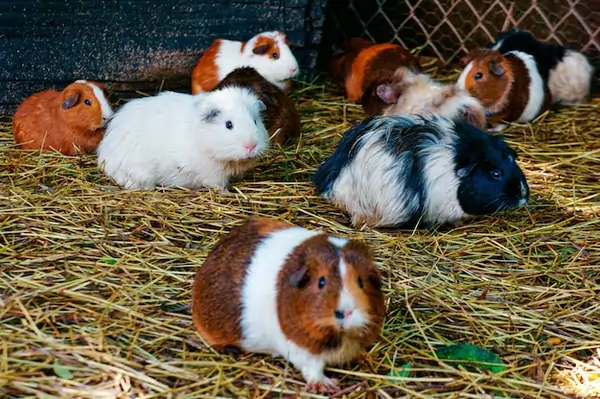
Guinea pigs, also called cavies, are among the most rewarding small pets for families with children. They are gentle, rarely bite, are active during the day making them easier to interact with than nocturnal species, and produce a wonderful range of vocalisations — purring, wheeping, and chattering — that make them engaging and charming companions. They must be kept in groups of at least two as they are highly social animals that suffer significantly from isolation — a solo guinea pig is a stressed, unhappy animal regardless of how much human interaction it receives.
Guinea pigs require a diet consisting primarily of unlimited fresh hay, which provides the dietary fibre essential for their continuously growing teeth and gut motility. Fresh leafy vegetables — particularly romaine lettuce, kale, cilantro, and bell peppers — should be provided daily. Bell peppers are an excellent source of Vitamin C, which guinea pigs cannot synthesise and must obtain from their diet. Vitamin C deficiency (scurvy) is extremely common in Indian-kept guinea pigs fed inadequate diets and manifests as lethargy, dental problems, rough coat, and lameness. Commercial guinea pig pellets supplement but should not replace hay and fresh vegetables in the diet.
Setting Up a Proper Home for Small Pets
Housing is one of the most frequently inadequate aspects of small pet care in India, where commercially available cages for hamsters, rabbits, and guinea pigs are very often drastically undersized for the animal's genuine needs. Understanding proper housing requirements before purchasing a small pet — and committing to providing appropriate space — is fundamental to responsible small pet ownership.
| Species | Minimum Enclosure Size | Essential Furnishings | Temperature Range |
|---|---|---|---|
| Syrian Hamster | 100cm x 50cm floor space minimum | Deep bedding (15cm+), wheel (28cm min), hides, tunnels | 18–24°C — vulnerable to heat above 25°C |
| Dwarf Hamster | 80cm x 50cm floor space minimum | Deep bedding, wheel (21cm min), multiple hides | 18–24°C |
| Rabbit | 180cm x 90cm minimum (larger is always better) | Hay rack, litter tray, hiding box, toys, chews | 10–26°C — sensitive to heat above 28°C |
| Guinea Pig | 120cm x 60cm for pair minimum | Hiding areas, hay rack, water bottle, fleece bedding | 18–24°C — no direct sunlight |
| Chinchilla | Multi-level cage, minimum 90cm x 60cm x 120cm tall | Ledges, dust bath container, hiding areas, chews | Strictly below 25°C — heat kills chinchillas |
| Rat | Multi-level cage, minimum 80cm x 50cm x 100cm tall | Hammocks, hiding areas, ladders, enrichment toys | 18–27°C |
Small Pets and India's Climate – Important Considerations
India's climate presents specific and serious challenges for several popular small pet species. Many small pets commonly kept in India are not adapted to tropical heat and can suffer from heat stroke and die if ambient temperatures are not carefully managed, particularly during the brutal April to June summers that affect most of North and Central India.
Hamsters are particularly vulnerable to heat. At temperatures above 25°C, hamsters become lethargic and uncomfortable. At temperatures approaching 30°C, they can enter a torpor-like state that is sometimes mistaken for death but is actually a dangerous form of heat stress. Above 32°C, hamsters face genuine risk of heat stroke and death. This means that in Delhi, Gurgaon, Noida, and most North Indian cities, hamster keeping requires air conditioning during summer months — a non-negotiable requirement that many prospective hamster owners in India do not appreciate before purchase.
Chinchillas are even more temperature-sensitive and cannot survive in temperatures above 25°C for extended periods. They are fundamentally unsuitable pets for most of India without year-round air conditioning and are not recommended for owners who cannot guarantee a consistently cool environment. Rabbits are also sensitive to heat and require shade, good ventilation, and cool surfaces or ceramic tiles to lie against during hot weather. Ice packs wrapped in towels and placed in the rabbit's enclosure during extreme heat can be life-saving measures.
Health Care for Small Pets in India
Finding a veterinarian with genuine expertise in small animal medicine — often referred to as "exotic pet" medicine even when the animals in question are commonly kept pets — is one of the most significant challenges of small pet ownership in India. Most veterinary training in India focuses on dogs, cats, and livestock, and many general practitioners have limited knowledge of the specific health issues, medication doses, and treatment approaches appropriate for rabbits, rodents, and other small pets.
Before acquiring any small pet, identify a veterinarian in your city who has demonstrable experience with the species you are keeping. Ask specifically about their experience — "Do you regularly treat rabbits / guinea pigs / hamsters?" and "What anaesthesia protocol do you use for rabbits?" are reasonable questions that reveal the depth of their expertise. Veterinary associations focused on exotic and small animal medicine can be useful resources for finding appropriately skilled practitioners.
Preventive health care for small pets includes regular observation for any changes in weight, appetite, faecal output, activity level, or coat condition — all of which can be early indicators of illness in animals that typically hide signs of sickness as an evolutionary survival behaviour. Weighing small pets weekly on a kitchen scale and recording the weight helps detect subtle weight changes that often precede visible illness. Rabbit and guinea pig teeth should be examined regularly, as dental disease is extremely common and can progress rapidly without obvious signs until the animal stops eating entirely.
Frequently Asked Questions About Small Pets in India
Are hamsters good pets for children? Hamsters can be good pets for children aged ten and above who are mature enough to handle them gently and respect their nocturnal schedule. They are not suitable for very young children who may handle them roughly or be frightened when they are bitten — which will happen if the hamster is startled or mishandled. Parental supervision of all child-hamster interactions is essential, particularly in the early weeks before the hamster is fully hand-tamed.
Do small pets smell? All animals produce odour, but small pets kept in properly sized, well-maintained enclosures with appropriate bedding that is changed regularly should not create significant odour problems. The smell associated with small pets in many people's experience comes primarily from enclosures that are too small, changed too infrequently, or use inappropriate bedding. Cedar and pine wood shavings, for example, contain aromatic compounds that are irritating to small animals' respiratory systems and should be avoided entirely in favour of paper-based bedding.
What is the easiest small pet to keep in India? For beginners, guinea pigs are often recommended as one of the most manageable small pets. They are gentle, social, active during the day, hardy relative to some other small pets, and their care needs — while not trivial — are well understood and consistently documented. Their need to be kept in groups of at least two is a requirement that adds cost but significantly enhances the welfare and engagement of the animals.
Can small pets be kept with dogs or cats? This requires very careful management and is not suitable for all temperament combinations. A dog or cat with a high prey drive is fundamentally incompatible with small pets, regardless of training. Even if coexistence seems peaceful during supervised interaction, small pets kept in homes with predatory dogs or cats live under permanent stress from proximity to a potential predator. House them in separate rooms with secure door barriers if both species are kept in the same home.